

Heel Striking vs Overstriding: What Runners Get Wrong About Foot Strike
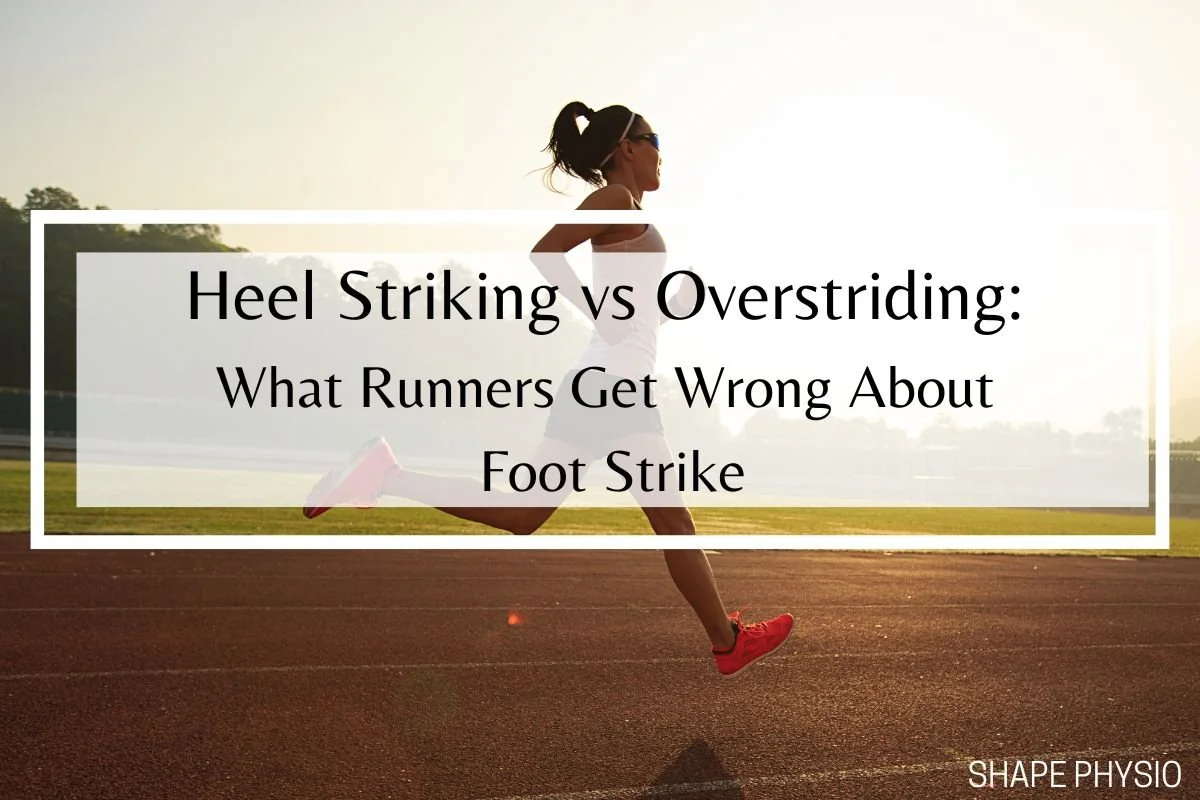
“You’re a heel striker, that’s your problem.” It’s one of the most common things runners hear, usually followed by advice to start landing on the forefoot instead. It sounds convincing, and the idea is everywhere. But the research tells a more nuanced story, and for most runners, heel striking isn’t the villain it’s made out to be.
The thing worth understanding is the difference between heel striking and overstriding, because they get confused constantly, and only one of them is worth keeping an eye on.
Heel Striking is Just How Your Foot Lands
Heel striking describes which part of your foot touches down first. You can be a heel striker, a midfoot striker, or a forefoot striker, and none of those is automatically right or wrong. If you land heel-first, you’re in good company: around 80% of long-distance runners are heel strikers (Bovalino & Kingsley, 2021).
On its own, foot strike is a weak and inconsistent predictor of injury. The evidence doesn't clearly show that heel strikers get hurt more overall (Burke et al., 2021).
Overstriding is Where Your Foot Lands
Overstriding is a different thing entirely. It’s not about which part of your foot lands, but where your foot lands in relation to your centre of mass. Specifically, it’s when your foot comes down well ahead of your body, often with a straight knee, so for a split second on every step your leg acts like a brake (Lieberman et al., 2015).a
The part most advice misses is that heel striking and overstriding are not the same thing. They get confused because overstriding often shows up alongside a heel strike. But you can heel strike with your foot landing close underneath you, which is completely fine. One is how your foot lands and the other is where it lands.
Why Overstriding is The One to Watch
There are two reasons it’s worth paying attention to overstriding. The first is efficiency. Those small braking forces on every step add up, making you work a little harder to hold the same pace and chipping away at your running economy over the course of a run.
The second is injury risk, and here the wording matters. Overstriding may increase the load on certain structures. A longer stride raises the load on your kneecap, which is part of why it's associated with runner's knee and IT band syndrome (Goss, Xu, & Hertel, 2025). Overstriding may increase load on certain structures, and it’s been linked to issues like runner’s knee (pain around the kneecap) and IT band syndrome. But the key word is may.
Running injuries are complex, and there’s rarely a single factor to blame. Training load, recovery, sleep, previous injuries, and plenty else all feed in. Overstriding is one piece of the puzzle worth understanding, not the whole story.
Why Forcing a Forefoot Strike Usually Backfires
This is why the standard fix, “just land on your forefoot,” misses the mark. While it’s true that you’re less likely to overstride with a forefoot strike, it’s not exactly a magic solution. Changing your foot strike doesn’t remove load, it just relocates it. Landing forefoot-first takes some stress off the knee but adds it to the calf, Achilles, and foot (Rice & Patel, 2017). You’re trading one set of demands for another.
It’s also one of the higher-risk changes you can make to your running. The tissues that suddenly have to absorb more, the calf and Achilles especially, adapt slowly, so runners who switch abruptly often pick up calf strains, Achilles pain, or foot and shin problems during the transition.
The Better Lever: Your Cadence
If you do suspect you overstride, the simplest and best-supported change isn’t your foot strike. Instead, looking at your cadence is more productive. This is how many steps you take per minute when running.
Nudging your step rate up by around 5% to 10% naturally shortens your stride and brings your foot closer to landing under your body. This reduces the braking and lowers the load through your knee and hip, all without consciously changing how your foot lands (Figueiredo et al., 2025).
One myth to bust is that you don’t have to hit 180 steps per minute. That number gets repeated everywhere, but it came from watching elite runners at race pace and isn’t a target everyone should chase. What matters is a small increase from your own current cadence, not a universal magic number. I usually recommend that runners check their current cadence on their watch (or I test it in the clinic), aim for roughly 5% more, and use a metronome app or a playlist at the right tempo. From there, we can build it in gradually over a few weeks rather than all at once.
So, Should You Change Anything?
For most healthy runners who aren’t getting injured, the honest answer is no. If you’re running comfortably, your foot strike is almost certainly fine, and chasing a “better” one is more likely to cause trouble than fix it.
The point of all this isn’t to send you away obsessing over your stride. It’s to help you become a more informed runner who knows the difference, so you’re not spooked by the next person who tells you your heel is the problem. If you’ve got a recurring niggle at the knee and you suspect you’re overstriding, a small cadence tweak is a low-risk thing to try, ideally with a bit of guidance from a physiotherapist treating runners.
When It’s Worth Getting Looked At
If your pain is sharp, lingers well beyond normal post-run soreness, or is getting worse, it’s worth having it assessed properly rather than experimenting with your form and hoping. Wherever you’re based, a physiotherapist can watch how you actually move and work out whether your gait is part of the picture.
If you’re in Melbourne and want a hand working out what is going on, you can book a free 10-minute discovery call or an appointment at Shape Physio Melbourne. Get in touch.
Not ready to book, or running somewhere further afield? You can still take this further. Download my free Runner's Guide to Strength Training for more on building a body that holds up through consistent running, and join the newsletter for evidence-based training tips made for runners.
Happy running,
April
References:
Bovalino SP, Kingsley MIC. Foot Strike Patterns During Overground Distance Running: A Systematic Review and Meta-Analysis. Sports Med Open. 2021 Nov 10;7(1):82. doi: 10.1186/s40798-021-00369-9. PMID: 34757569; PMCID: PMC8581084.
Burke A, Dillon S, O'Connor S, Whyte EF, Gore S, Moran KA. Risk Factors for Injuries in Runners: A Systematic Review of Foot Strike Technique and Its Classification at Impact. Orthop J Sports Med. 2021 Sep 9;9(9):23259671211020283. doi: 10.1177/23259671211020283. PMID: 34527750; PMCID: PMC8436320.
Figueiredo I, Reis E Silva M, Sousa JE. The Influence of Running Cadence on Biomechanics and Injury Prevention: A Systematic Review. Cureus. 2025 Aug 17;17(8):e90322. doi: 10.7759/cureus.90322. PMID: 40964543; PMCID: PMC12440572.
Goss DD, Xu J, Hertel J. Effects of step rate based gait training on running biomechanics: A systematic review and meta-analysis. Gait Posture. 2026 Jan;123:110009. doi: 10.1016/j.gaitpost.2025.110009. Epub 2025 Oct 11. PMID: 41092785.
Lieberman DE, Warrener AG, Wang J, Castillo ER. Effects of stride frequency and foot position at landing on braking force, hip torque, impact peak force and the metabolic cost of running in humans. J Exp Biol. 2015 Nov;218(Pt 21):3406-14. doi: 10.1242/jeb.125500. PMID: 26538175.
Rice H, Patel M. Manipulation of Foot Strike and Footwear Increases Achilles Tendon Loading During Running. Am J Sports Med. 2017 Aug;45(10):2411-2417. doi: 10.1177/0363546517704429. Epub 2017 May 1. PMID: 28460179.